
When protecting your home or business, a CCTV camera power supply is more important than most owners realise. The right CCTV camera power supply keeps your cameras running. It also affects footage quality, system reliability, and your protection against threats. Without a stable, reliable power source, even advanced security cameras can fail when you need them most. This clear guide explains what you need to know about CCTV camera power supplies. It also shows how they affect your security system’s performance and reliability.
What Is a CCTV Camera Power Supply?
A CCTV camera power supply is a special electrical unit that provides the right voltage and current. It powers surveillance cameras and related equipment. Think of it as the backbone of your security system. Without it, your cameras cannot capture or send video.
How CCTV Power Supply Works
Your CCTV system’s performance depends on understanding how power flows through it. CCTV cameras require a power source to function.
They use electricity to power electronic components, including the lens, image sensor, infrared LEDs, and other electronics.
The performance of CCTV systems depends on three electrical characteristics: current, voltage, and power. The power supply converts AC power from your wall outlet to DC power that your cameras can use. Different cameras require specific voltage levels. generally either 24V or 12VDC. The power supply should meet the specific voltage required by each camera.
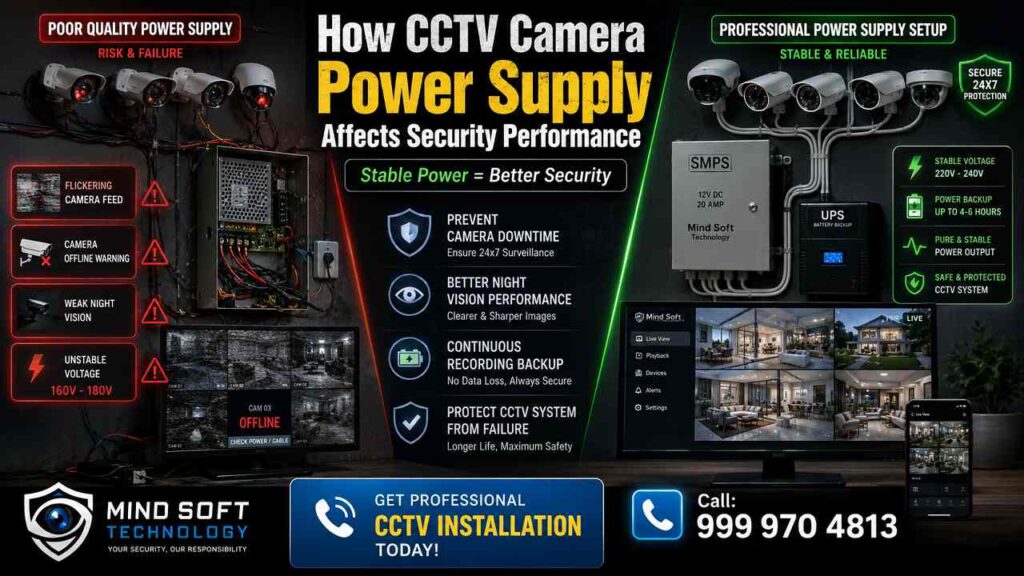
Why Stable Power Is Important for CCTV Systems
Stability is essential for security cameras. A power supply that provides stable, clean power can minimise image distortion and signal noise. This could improve CCTV quality. CCTV system.
If your power supply fluctuates or produces a fluctuating voltage, your cameras could fail. Providing the correct amount of power helps the cameras last longer. It also shields cameras from power fluctuations and surges. This means that there is less necessity for expensive fixes or repairs. A reliable power source will provide clear video, continuous recording, and equipment that lasts longer.
Types of CCTV Camera Power Supplies
Not all power supplies are created equal. Let’s explore the main options available for your security system.
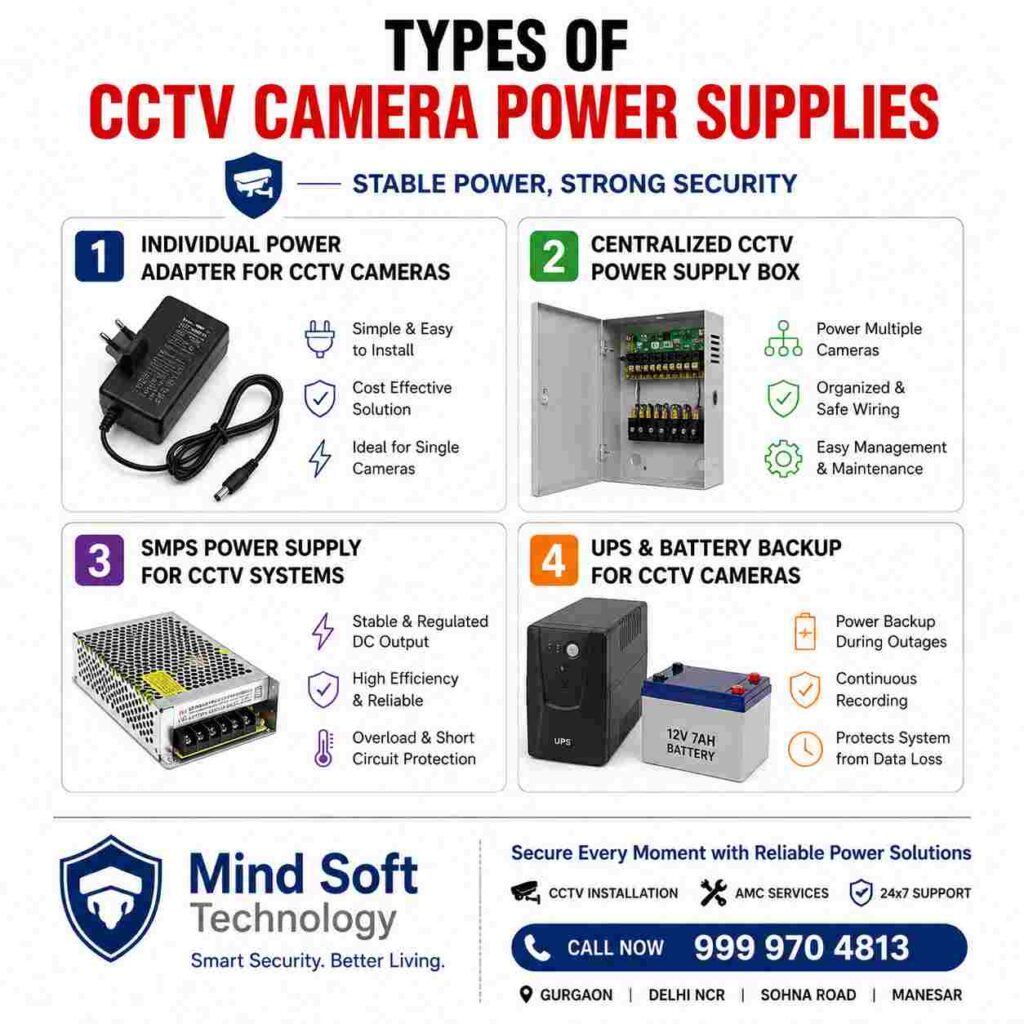
Individual Power Adapter for CCTV Cameras
The simplest option is to use one power adapter for each camera. Many security cameras include a plug-and-play power adapter.
You can plug it into a standard electrical outlet.
It usually provides low-voltage DC power, such as 12V or 24V DC.
While handy for small setups, individual adapters are hard to manage and messy with many cameras. They also make troubleshooting hard and waste power outlets.
Centralized CCTV Power Supply Box
A centralised power supply box is the professional choice for multi-camera installations. A centralised power supply keeps wiring neat by providing a single power input. It makes your setup look professional, not like a web of adapters. It also makes monitoring easier because you can check your system’s power status in one place. When something goes wrong, troubleshooting is simpler because each camera output usually has its own fuse.
SMPS Power Supply for CCTV Systems
The SMPS (Switched-Mode Power Supply) models are the standard of modern security systems. Contrary to conventional linear power sources, SMPS use fast switching to regulate voltage and cut energy loss. This makes them perfect for security camera installations that require continuous, stable power.
SMPS technology is highly efficient. It transforms input power into output power usable without a loss of energy. This reduces operating costs as well as heat output. This also prolongs the life of the power supply component. In addition, SMPS units are compact and lightweight. They are ideal for CCTV setups that have limited space.
UPS & Battery Backup for CCTV Cameras
Mission-critical security applications require a UPS (Uninterruptible Power Supply). It is crucial. With a UPS backup power source, your security cameras stay on even during a power failure.
Typically, a security battery backup can run for up to 24 hours. During a power outage, this time may vary. It depends on the system’s power use and the battery’s condition. If you face long outages, pair a UPS with backup generators for full security.
How to Choose the Right CCTV Power Supply
Selecting the correct power supply requires understanding several technical factors.
Voltage & Ampere Requirements Explained
The most common mistake is choosing a power supply without first calculating your real power needs. Ensure the power supply provides enough current in amperes. For example, if a camera needs 0.5A, the power adapter should supply at least 0.5A. Exceeding the required current is fine, but too little current may stop the camera from working.
A common rule of thumb is that a voltage drop of no more than 10% is acceptable. For example, 10.8V is usually enough to power a 12V camera. If you exceed this limit, your cameras will not work properly.
Selecting Power Supply Based on Camera Quantity
For large installations, the ideal rule is to multiply the needed capacity by 1.3. This can help cover energy demand during startup or transmission. In systems with multiple cameras, sizing the power supply requires more than simply summing each camera’s power rating.
Indoor vs Outdoor CCTV Power Solutions
Indoor setups are typically less demanding, however outdoor installations face tough environmental issues. For long distances, a 12-volt power supply could lose the voltage and affect camera performance. In such instances the use of a more robust cable or choosing an more powerful frequency (24V AC) will ensure a steady connection. If you are using it outdoors be sure that the electrical supply is waterproof. Keep it dry from the elements.
CCTV Camera Power Supply Connection Guide
Step-by-Step CCTV Power Connection Process
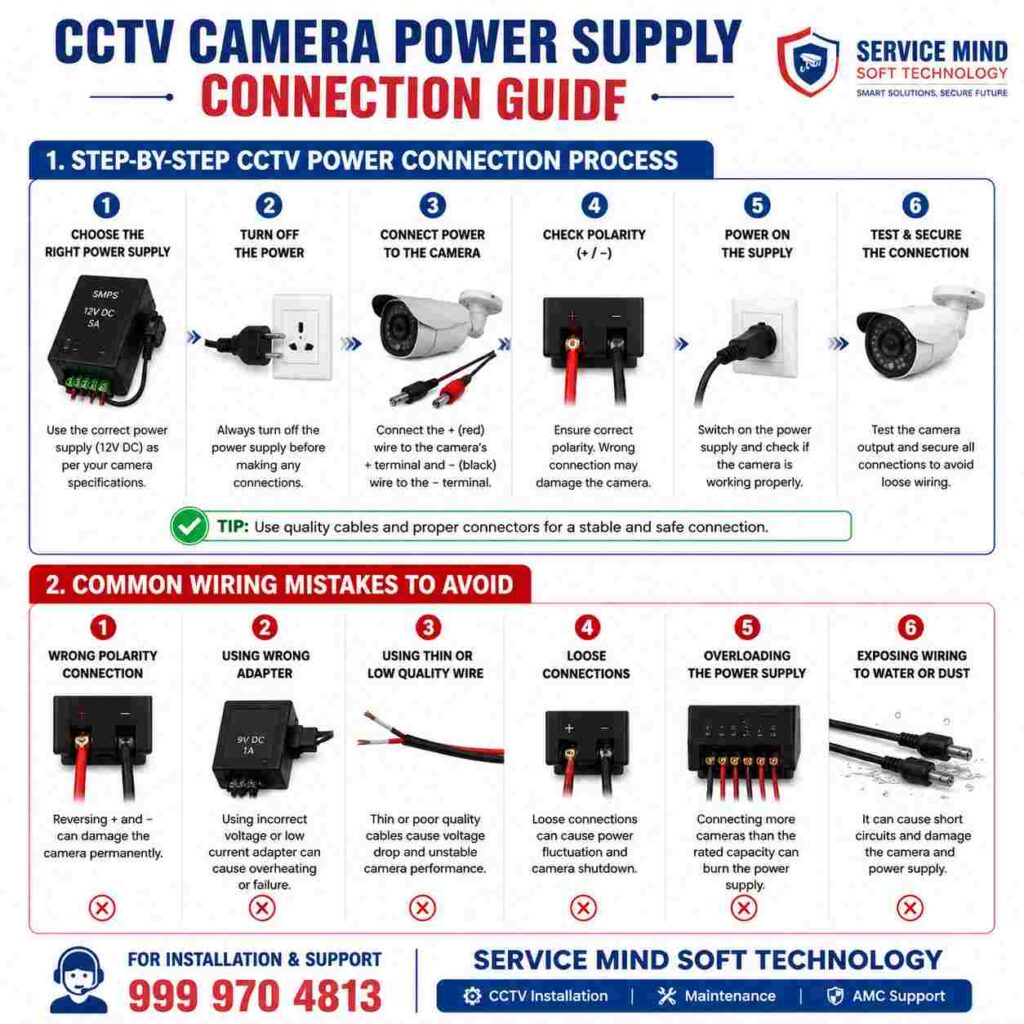
An effective installation is vital. Before beginning the installation, take precautionary steps. Shut off the power. Wear protective clothing, including the gloves you use and your safety eyewear. Test the voltage with a voltage tester. Pick a location that is suitable and well-ventilated.
Make sure you connect your negative (red) and Negative (black) cables to the proper terminals. When using DC power, the polarity of the wire is crucial. Make sure you connect the positive wire with the proper terminal block. Connect the common or ground wire to the lower block.
Common Wiring Mistakes to Avoid
The most dangerous mistake is reversing polarity. Connecting positive and negative the wrong way can damage your cameras fast. Reversing polarity can cause your cameras to malfunction or get damaged. Always double-check the wire colours: red is positive (+), black is negative (–).
Never run camera video or power cables in the same conduit as power lines. AC power in those lines can ruin video signal quality. Keep cables at least 6 inches from electrical wiring.
Common CCTV Power Supply Problems & Solutions
Camera Flickering or No Video Signal
This is one of the most frustrating issues you’ll encounter. Flickering video often occurs due to voltage fluctuations from unstable power supplies. Visual glitches, such as lines, static, or distorted colours, can appear in footage.
Camera restarts or freezes can also happen.
These issues are caused by unstable voltage.
The solution? Test the output of your power supply with a multimeter. Make sure it delivers a stable voltage.
Power Drop Issues in Long Cable Runs
Voltage drop can be a silent threat to the performance of security cameras. It’s like drinking the milkshake with a long straw. The farther it has to go, the harder it becomes to achieve the results you want.
When you reach 100 feet using standard 18 AWG wire, voltage drop is your adversary. The solution could be to use larger cables, switch to 24V AC power, or use power over Ethernet. Each choice has advantages for your requirements.
Overheating & Power Failure Problems
Overheating equipment signals strain on your power supply. Hot power adapters or cameras indicate the system is working beyond its capacity. Ensure your power supply box has adequate ventilation and isn’t placed in direct sunlight or confined spaces.
Benefits of Using High-Quality CCTV Power Supplies
Improved Camera Performance & Stability
Quality power supplies give steady voltage. This keeps your cameras running at peak performance. Sharp video, reliable night vision, and smooth motion detection all need steady power.
Better Protection Against Voltage Fluctuations
Modern power supplies include surge protection, overvoltage protection, and short-circuit protection. These safeguards stop damage from electrical spikes that could otherwise ruin your whole system.
Longer Lifespan for CCTV Cameras
By protecting your cameras from power stress, a good power supply can extend their life by years. It can save you thousands in replacement costs.
Best CCTV Power Supply Brands in India
CP Plus CCTV Power Supplies
CP Plus CCTV Power Supplies include multiple output channels or ports. They allow users to power multiple devices simultaneously from a single power source. They also include security features like overcurrent, voltage, and short-circuit protection. These features ensure that connected devices are secure. CP Plus offers a range of choices from 4 to 16 channels. It also comes with versions made of metal and plastic.
Hikvision Power Supply Solutions
Hikvision power supplies are built with solid construction and surge protectors. They safeguard the devices they connect to from voltage spikes. There are a variety of options from 8 channels to 16 channels. The Hikvision DS-2FA120A DW-IN is BIS certified. It features a fully designed Switch-Mode power supply. This enables reliable professional installations.
Dahua CCTV SMPS Units
Dahua offers competitive SMPS units for its surveillance systems.
They have strong thermal management and protection features for Indian climate conditions.
Reliable CCTV Accessories from IT Security India
For full security solutions, trusted suppliers offer complete packages. These include power supplies, accessories, and installation support.
CCTV Power Supply Installation Tips
Safety Measures During Installation
Wear protective gear, including gloves and safety glasses, when handling electrical equipment. Use a voltage tester to check the voltage before you start. Make sure the power is off and safe to work on. Never work on live circuits.
Proper Cable Management for CCTV Systems
Use cable ties or clips to keep everything organised, safe, and easy to troubleshoot. Poor cable management, with messy, tangled cables, can be a major hazard. It can also make future maintenance very hard. Organise cables neatly and avoid sharp bends. Use conduit for outdoor runs.
When to Hire Professional CCTV Installers
If your installation needs cables run through walls, hire a licensed electrician.
If it involves complex wiring, hire a licensed electrician.
If it needs work on existing electrical systems, hire a licensed electrician. Professional installers make sure your system meets local electrical codes and works well from day one.
Conclusion
Final Tips for Choosing the Best CCTV Camera Power Supply
When selecting the security camera’s power source, keep these factors in mind.Find out your actual power requirementPick SMPS units over lower-cost alternatives.Make sure the device is well ventilated.Always adhere to the marked polarity. Don’t compromise on quality. A reliable power source is the basis of effective surveillance.
Why Quality Power Supply Matters for Security Systems
Your security system is only as strong as its weakest part. That part is often the power supply. A quality unit supports steady surveillance. It helps keep video footage clear. It can also make your equipment last longer. Whether you’re protecting a small home or a large business site, the right CCTV camera power supply is vital.
Ready to Upgrade Your Security System?
Contact Mind Soft Technology today for expert CCTV power supply solutions and professional installation services.
Solutions and installation professionals.
Call Now: +91-999 970 4813
Our team of experts offers:
- Comprehensive system assessment and consultation
- Power supplies of high quality from the top brands
- Professional installation, with safety conformity
- 24/7 technical support
- Pricing that is competitive and comes with a warranty
Don’t let a weak power source cause a security risk. You can trust Mind Soft Technology to keep your surveillance system functioning smoothly all day, every day of the year.
Mind Soft Technology – Your Security Partner to provide Peace of Mind
FAQs – How CCTV Camera Power Supply Affects Security Performance
What is a CCTV camera power supply?
A specialized unit that converts AC wall power to DC or AC voltage, like 12V DC or 24V AC.
It powers cameras, sensors, and LEDs.
It is the backbone of your surveillance system.
Why is stable power important for CCTV cameras?
It prevents image distortion, flickering, and signal interference. It also helps avoid surge damage. This ensures clear video, reliable recording, and a longer camera lifespan.
What are the main types of CCTV power supplies?
Individual adapters (simple for single cameras).
Centralized boxes (neat for multi-camera setups with fuses).
SMPS units (efficient, compact, low-heat for modern installs).
UPS backups (for outages, up to 24 hours).
How do I calculate the right power supply for my cameras?
Add up each camera’s amp needs (for example, 0.5A per camera).
Multiply the total by 1.3 to handle peak loads.
Match the required voltage (12V DC is common).
Keep the voltage drop under 10% over cable runs.
What’s the difference between 12V DC and 24V AC power?
12V DC suits short indoor runs but drops over distance. 24V AC handles long outdoor cables with less voltage loss. It is ideal for larger setups.
How can I fix flickering or no video from power issues?
Test the output with a multimeter for a stable voltage. Check for loose wires, reversed polarity, or overloads—use thicker cables or PoE for long runs.
Which brands offer reliable CCTV power supplies in India?
– CP Plus: 4 to 16 channels. It includes safety protections.
– Hikvision: BIS-approved SMPS. It is surge-proof.
– Dahua: It is thermally efficient. It works well in Indian conditions.