
Integrating CCTV with other security systems turns separate gadgets into one team. They monitor, verify and respond as a unit. A camera by itself only captures. A door reader alone only validates a credential. An alarm by itself only creates a disturbance. Link them together, and each one completes the other’s deficiency. If you manage a home, office, factory or society in Gurgaon, Manesar, Sohna, Noida, Ghaziabad or Delhi NCR, this manual explains how integration works and what benefits it offers. This manual also explains how to integrate them correctly.
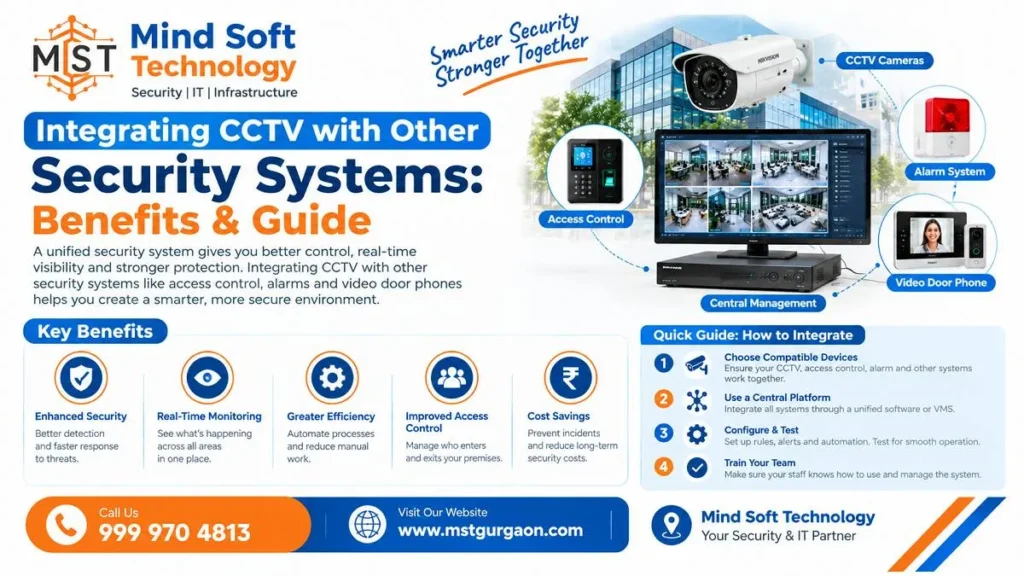
How CCTV Works with Access Control and Alarm Systems
Access control decides who can enter. Alarms warn you when something is wrong. CCTV shows you what is actually happening. Here is how each pair works.
How CCTV Cameras Work with Access Control Systems
Access control uses credentials to identify authorised people, but it does not give full visibility of a site. CCTV adds that missing view. When someone uses a card at a door reader, the access control system records the event. It then sends the event to the video management system. The video links the footage to that entry automatically. You can even set a live camera pop-up whenever a door event happens.
Imagine a proximity card is lost or stolen. With access control alone, door readers cannot tell the right person from the wrong one. They may let the wrong person in. Video analytics can help the camera verify the cardholder. It can raise an alarm if an imposter uses the card. Tailgating can be detected with integration and cannot be prevented with access control alone.
How CCTV Cameras Work with Intrusion Alarm Systems
When an alarm is triggered, an integrated CCTV system can aim cameras at the intrusion area. It can record the event and alert the authorities. This helps you verify threats in real time and reduces false alarms.
That matters because traditional intrusion alarms have no way to verify threats. High false alarm rates make it hard for police to prioritise a response. Hikvision’s IVaaS technology, for example, sends a 7-second clip to your email or app.
It includes 5 seconds before the alarm and 2 seconds after. Risco’s VUpoint solution can send clips up to 30 seconds to a smartphone app. This helps you judge if the threat is real.
Benefits of Integrating CCTV with Other Security Systems
Improved Security and Prevention of Unauthorized Access
When paired with live video, you get undeniable proof with no need for guesswork. Live video and access logs help shift security from reactive to proactive. You can look back on incidents to help better understand what went wrong. Match each access attempt with its video, instead of searching separate systems.
Centralized Monitoring and Faster Incident Response
Alarms usually come from three places: CCTV, intruder alarms and access control. When these run on one IP network, an event in one system can trigger an action in another. If all the software uses the same login mechanism, one login can give you access to every system. Some platforms go further and combine video, access control, audio, and alarm events in one control point. This helps your team react faster.
Integrating CCTV with Fire Detection and Alarm Systems
Fire is one more place where cameras help. Video fire detection uses analytics to spot fire and smoke early. It does not wait for heat or smoke particles to reach a sensor. It can even detect fire or smoke through glass doors and windows.
Integration also helps after the alarm sounds. Siemens’ Sinteso Video Fire Controller records or sends CCTV images after an alarm triggers. Fire and security officers can find the alarm source without ordering unneeded evacuations.
They can send the video to the fire service before dispatch. Other platforms, like CathexisVision, link fire events to specific cameras. This enables real-time visual verification. Hikvision has also linked Teknim fire alarm panels to its HikCentral Professional software using BACnet.
This gives teams the ability to monitor panels and use CCTV features. Users can take screenshots, record streams and get notified of events. This reduces the amount of blind spots and expedites verification for the emergency response team.
Smart Security Automation and Real-Time Monitoring
AI video analytics uses AI and computer vision to analyse video in real time. Traditional CCTV is mainly a recording tool. Analytics adds real-time detection and instant alerts. Alerts can use SMS, email, push notifications, or webhooks. Operators do not have to watch every feed all day. Operators can set alert rules using specific criteria. These can include clothing color or facial recognition. Edge processing can also cut delay and bandwidth costs. This helps when alerts are urgent.
Recording is becoming smarter too. Facilities are starting to log video at an entrance instead of storing hours of footage. They are keeping a clip each time the access control system is activated. Some of the systems are also capturing the alarm clip at the control panel. This is valid even if an intruder sabotages the camera and detector. Indian platforms like Innefu’s AI Vision also support offline analysis of recorded footage. This helps with forensic checks.
Best Practices for Integrating and Maintaining CCTV Security Systems
Choosing Compatible CCTV Cameras and Security Systems
Not every brand of CCTV will work with every access control or alarm system, so check this before you buy. Confirm that the systems integrate natively or through supported APIs. Once you have decided on outcomes, ONVIF is the way to go. ONVIF lets IP cameras, recorders, and software talk to each other. It helps them work together across different vendors. Profile S outlines the most basic elements of ONVIF. For deeper access control and event management across vendors, you need Profiles A and C.
Keep realistic expectations, though. ONVIF conformance does not mean there will be perfect interoperability. Results may also be affected by firmware versions and network settings. The network also needs to be well optimized for the data to be able to flow freely. Lastly, decide on a setup. For a cloud setup, you get remote access and the ability to scale. For a local setup, you get more control, and your data remains private.
Regular Testing, Maintenance and Software Updates
After configuring your systems, test them end-to-end. Keep firmware updated, use strong passwords and restrict network access. Updates matter, but they can also affect integrations.
One vendor reports that some firmware updates broke ONVIF compliance in the past. Retest your links after every update.
Conclusion
Integrating CCTV with other security systems helps you confirm alarms. It links each alarm to the right footage. It speeds up your response. It gives you one clear view of your site. Start with the system that matters most to you. This may be door access, intrusion alarms, or fire safety. Make sure everything is compatible, tested, and up to date.
Get the Best Price on CCTV Integration from Mind Soft Technology
Want a CCTV system that works smoothly with your access control, alarms and fire panels? Mind Soft Technology offers the best price with hassle-free installation.
📞 Call now for the best price & Installation: 9999704813 📍 Service Areas: Gurgaon, Manesar, Sohna, Noida, Ghaziabad, Delhi NCR
FAQs: Integrating CCTV with Other Security Systems
1. What does integrating CCTV with other security systems mean?
It means linking your cameras with systems like access control, intrusion alarms, and fire alarms. They share events and work together. For example, a door entry or an alarm can automatically link to the related video footage.
2. Why integrate CCTV with an access control system?
Access control only checks credentials, while CCTV shows who actually entered. Together, they help you spot tailgating and the use of a lost or stolen card. They also speed up incident reviews. Each entry is matched with its video.
3. Does CCTV integration reduce false alarms?
Yes. Video verification lets you see what triggered an intrusion alarm before you send anyone. Some systems send a short clip from just before and after the alarm to your phone or email so you can confirm if it is real.
4. Can CCTV cameras help with fire detection?
Yes. Video fire detection uses analytics to spot smoke or flames early, without waiting for smoke or heat to reach a sensor. When connected to a fire alarm panel, operators can view related video on screen. They can confirm the alarm before ordering an evacuation.
5. Will all CCTV cameras work with other security systems?
Sometimes. Compatibility depends on the manufacturer. You should always check before purchasing. ONVIF is an industry standard. It helps different brands of IP cameras and recorders be compatible with different NVRs and video management systems. Keep in mind, it doesn’t guarantee perfect communication. Network configurations and firmware can always have an effect on it. Make sure to test after every software/firmware upgrade.